
  • 1605 N Cedar Crest Blvd Suite 502 Allentown, PA 18104
What we do

Pulse Wave (EPAT), for the stubborn ones that will not settle.
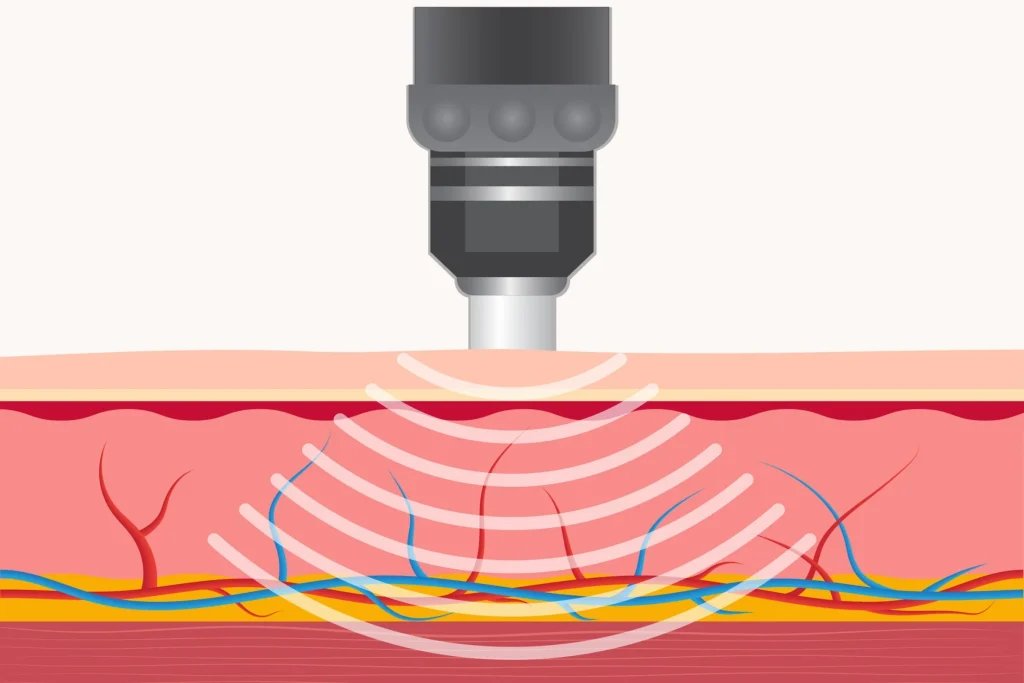
Shockwave therapy in Allentown, used alongside chiropractic care for long-running tendon and heel problems that have stopped responding to rest and to everything else you have tried.
⏱ Same-week new-patient visits
⚡ Drug-free, no downtime
📍 Serving Allentown
A Pulse Wave (EPAT) handpiece in use over the heel during a session in Allentown
The short answer
Shockwave therapy sends rapid acoustic pressure waves through the skin into a specific spot with a handpiece. The idea is to stir up a stalled area and prompt the body to get on with repairing it. It is drug-free, non-invasive, and needs no downtime, and it is aimed squarely at long-running tendon and heel problems rather than at everyday aches. Unlike most of what we do it is not especially comfortable while it is happening, and we would rather you heard that from us first.
Shockwave is one of the more interesting tools we have and one of the easiest to oversell. Here is the grounded version: what it actually is, what it feels like, the problems it genuinely suits, and where the evidence is stronger and weaker.

What is shockwave therapy?

A handpiece is pressed against the skin over the problem area and delivers a rapid series of acoustic pressure waves into the tissue below. It is mechanical energy rather than electrical, and nothing enters the body. You will hear a firm tapping and you will feel it clearly.
The thinking is that a tendon or fascia sore for months has settled into a stalled state, where the normal repair process has quietly given up. The waves are used to interrupt that and prompt the area to start responding again. We use it as one part of a plan, alongside the hands-on work and the loading that rebuild the tissue properly.

Who is it for?

This is the one we reach for when something has been going on for months rather than days, and when rest, movement, and hands-on work have taken it as far as they will go on their own.
  • Heel pain and plantar fasciitis that has outlasted the usual advice.
  • Long-running tendon problems at the elbow, shoulder, knee, or Achilles.
  • An area that improves with care and then slides back to where it started.
  • Active people who want a non-invasive option before considering anything stronger.
It is a poor fit for a fresh injury, for general stiffness, and for pain that is not coming from tendon or fascia at all. There are also situations where we would not use it, including pregnancy, over a known clot, over an active infection, or near a growth plate in a child. A short check before we begin settles all of that.

Does it hurt?

Somewhat, and we would rather be straight about it than have you surprised. Most people describe a strong, rapid tapping that is uncomfortable while the handpiece is over the sore spot, particularly in the first minute. It is brief, we can adjust the intensity as we go, and it usually eases off during the session itself. Nobody should be gritting their teeth through it, and if you are, we change something.

Is shockwave proven to work?

For long-standing heel pain and several tendon problems the evidence is reasonably encouraging, and it is one of the better supported options we offer for those specific complaints. Push beyond them and the picture thins out quickly. We offer it for the problems it actually suits, and we will say plainly when your situation is not one of them rather than sell you a course of it.

What does a session involve?

We locate the exact sore spot, apply a little gel, and work the handpiece over the area for a few minutes. You are in and out quickly and can drive, work, and carry on as normal afterwards. The area can feel tender or slightly achy for a day, which is expected. Shockwave is usually done as a short series a week or so apart rather than as a one-off, and we review whether it is earning its place as we go.
  • No referral needed to book a first visit.
  • We go over the costs with you before anything begins, so you know what to expect.
  • Clear, up-front pricing if you are paying out of pocket, with no packages you did not ask for.
Coverage for shockwave varies by plan and it is often not covered at all. We cannot promise a specific outcome or what your insurance will pay. What we can promise is an honest read on whether your problem is the kind shockwave actually suits, and a straight answer if it is not.

For the problem that will not settle.

Same-week visits for new patients. Come as you are, we will take it from there.

Why patients choose this care

Aimed at the stubborn ones

Built for long-running tendon and heel problems, not for everyday aches that will settle on their own.

Drug-free, no downtime

Nothing enters the body and nothing to recover from, so you drive home and carry on with your day.

Honest about the discomfort

It is not the comfortable one, and we tell you so before we start rather than after.

What your care looks like

1

Work out if it fits

We check whether your problem is the kind shockwave actually suits, and say so plainly if it is not.
2

The session itself

A few minutes with the handpiece over the exact sore spot, with the intensity adjusted to what you can handle.
3

Paired with your care

We combine it with the hands-on work and loading that address why the area got overloaded.
4

Reviewed as you go

We look at whether it is genuinely helping rather than running to a fixed number of visits.
Reviews

What patients say

⭐⭐⭐⭐⭐
“Flexible with changing scheduled appointments and responsive to need for replacement products. Always cheerful and interested in my progress noting the recent office arrival without use of a cane!”
Greg Emmons (MistoryE)
⭐⭐⭐⭐⭐
“Well informed information from the doctor, to the root of the problem. The staff were polite and friendly.”
Jerry Hartman
⭐⭐⭐⭐⭐
“A very concerned and interesting staff that all are working together to make you feel better. Always walk out better than walking in.”
Jay Alexander

Shockwave questions we hear most

It is normally a short series spaced about a week apart rather than a single visit, because the response builds over time. We review as we go and stop if it is not earning its place, rather than committing you to a block up front.

Laser is light energy and you feel a gentle warmth; shockwave is mechanical pressure and you feel a firm tapping. Laser tends to suit a generally irritated area, while shockwave is aimed at a specific, long-standing tendon or heel problem. They are used for different jobs rather than as alternatives to each other.

It has a good safety record for the problems it suits when done by someone trained to use it. The area can be tender for a day afterwards, which is expected. There are situations where we would not use it, including pregnancy, over a known clot or an active infection, and near a growth plate in a child, which is what the check beforehand is for.

Yes, and it usually works best that way. Shockwave is aimed at the stubborn spot itself, while the rest of your care addresses the movement and loading that let it get overloaded in the first place. On its own it tends to be a shorter-lived win.

You might also look at

Plantar fasciitis

The heel pain shockwave is most often aimed at here.

Sports injury

The long-running tendon problems it suits best.

Laser therapy

The gentler option for a generally irritated area.

Weight Loss New Patient Special

Complimentary consultation for our state-of-the-art weight loss program
  • Free consultation
  • Personalized weight loss program focused on healthy eating, real results, and no medications or injections

Chiropractic New Patient Special

$49
$49 includes a detailed consultation, posture analysis, and a full exam
  • Detailed consultation
  • Posture analysis
  • Full exam

Neuropathy New Patient Special

$49
$49 consultation and thermal scan
  • Detailed health history
  • Specialized neurosensory exam
  • Advanced thermal camera imaging to evaluate blood flow and nerve function