
  • 1605 N Cedar Crest Blvd Suite 502 Allentown, PA 18104
What we do

Knee on Trac, for the knee that hurts every time you stand up.
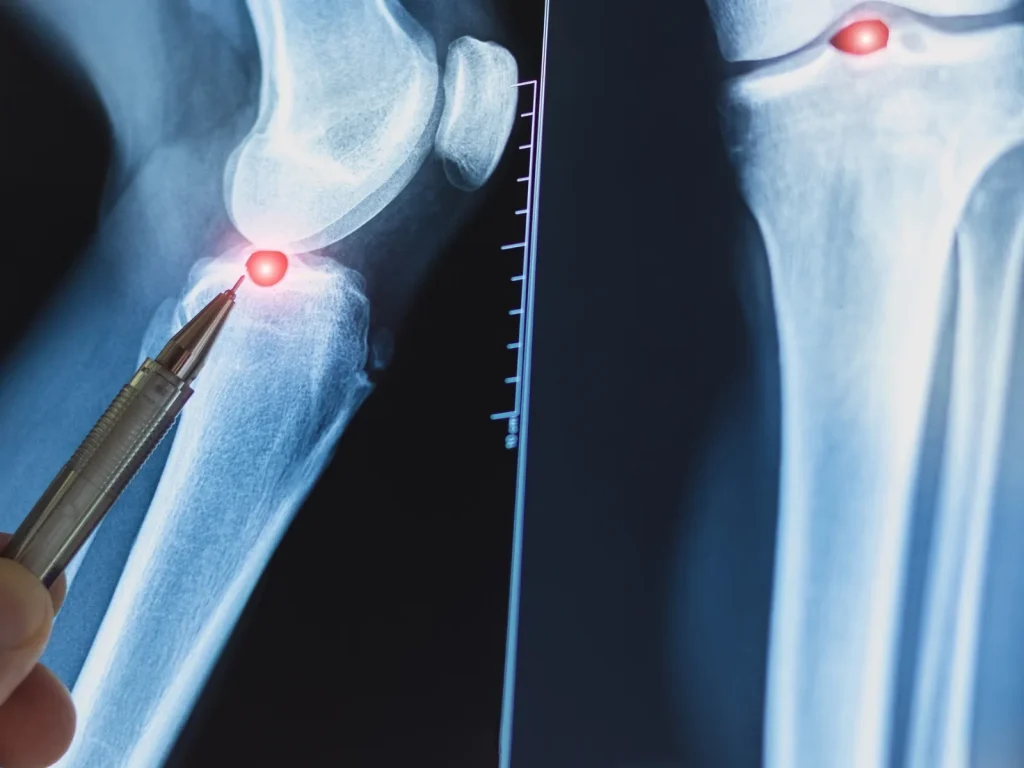
Gentle mechanical knee decompression in Allentown, used alongside chiropractic care for knees that ache going down stairs, stiffen after sitting, and have been told surgery is the only thing left.
⏱ Same-week new-patient visits
⚡ Non-invasive, no downtime
📍 Serving Allentown
A patient's leg positioned in a Knee on Trac unit during a session in Allentown
The short answer
Knee decompression uses a machine to apply a gentle, rhythmic pull along the leg, easing the joint surfaces apart a few millimetres at a time. The aim is to take load off a knee that has been grinding under pressure for years, and to move fluid and nutrition through cartilage that does not get much of either. It is non-invasive, there is no recovery time, and most people find it comfortable enough to relax through. It is not a rebuilt knee and nobody should sell it as one.
Knee pain is one of the areas where people are most often told there is nothing to be done short of surgery. That is not always true, and it is also not always false. Here is a straight account of what knee decompression is, who it tends to suit, what a session is actually like, and where the honest limits of it are.

What is knee decompression?

Your leg is secured into a padded unit and the machine applies a slow, cyclical pull along the line of the joint, then releases, then repeats. The force is modest and it builds gradually. Most people describe it as a firm stretch through the knee rather than anything sharp, and plenty find it pleasant enough that they get comfortable and stay quiet for the twenty minutes.
The reasoning is straightforward. A knee carrying years of compressive load has very little space left in it, and cartilage has no blood supply of its own. It feeds by being loaded and unloaded, drawing fluid in and pushing it out like a sponge. A joint that is permanently squashed loses that pumping action. Easing the surfaces apart on a cycle restores some of the space and some of that exchange, which is why sessions are rhythmic rather than one long steady pull.
It is almost never done on its own. The knee is usually hurting partly because of how the hip, ankle and lower back are sharing the work, so decompression sits alongside adjusting, soft tissue work and specific loading you do at home. On its own it is a passive input, and passive inputs alone rarely hold.

Who is it for?

  • Knees that ache going down stairs or standing up after sitting a while.
  • Wear-and-tear knee pain where the joint space has narrowed over the years.
  • Knees that stiffen up overnight and take a while to get going in the morning.
  • People who have been told the next step is surgery and want something to try first.
  • Anyone who wants a non-invasive option before considering injections.

Who it is not for

It is not the right call for an acute injury, a knee that is hot, swollen and angry, a recent fracture, an unstable joint, or a knee with hardware in it from previous surgery. Advanced bone-on-bone change with severe deformity is usually past what this can help, and the honest answer there is a conversation about what surgery would involve. We check for all of this at the first visit and will say so plainly if you are in that group.

What a session is actually like

You stay fully clothed. Your leg is fitted into the unit, the machine works through its cycle for roughly fifteen to twenty minutes, and you get up and walk out. There is no downtime and no restriction afterwards. Some people feel a mild ache the same evening, in the way a new exercise leaves you aware of a joint; that generally settles by the next day and eases as you go on.
It is a series, not a single visit. Knees that have been sore for years do not turn around in one session, and any claim otherwise should make you suspicious. We review as we go, and if the pattern is not moving after a fair run we will tell you rather than keep booking you in.

An honest view of the evidence

This is where we would rather be straight with you than impressive. The research base for mechanical knee decompression is much thinner than for spinal decompression, and thinner than for shockwave. Traction of the knee is a long-standing idea with sound mechanical logic behind it, and the studies that exist are mostly small. What we can say honestly is that we see people get real relief from it, that it carries very little risk, and that it is worth a defined trial before anything irreversible. What we will not do is quote you a success rate we cannot stand behind.

Cost and insurance

  • No referral needed to book a first visit.
  • We go over the costs with you before anything begins, so you know where you stand.
  • Clear pricing up front if you are paying out of pocket, with no packages you did not ask for.
Coverage for knee decompression varies by plan and it is frequently not covered. We cannot promise a specific outcome or what your insurance will pay. What we can promise is an honest read on whether your knee is the kind this suits, and a straight answer if it is not.

Worth trying before anything irreversible.

Same-week visits for new patients. We will tell you honestly whether your knee suits it.

Why patients choose this care

Takes load off the joint

Eases the surfaces apart on a cycle, giving a knee that has been compressed for years some room to work with.

Something to try first

A defined, reversible trial for people who have been told surgery is the only option left.

Part of a plan, not a machine on its own

Paired with hands-on care and specific loading, because the hip and ankle usually have a share in a sore knee.

What your care looks like

1

Work out if it fits

We examine the knee, look at how the hip and ankle are loading it, and say plainly whether this is the right call for you.
2

The session itself

Fully clothed, leg fitted into the unit, fifteen to twenty minutes of gentle cyclical pull. Most people relax through it.
3

The rest of the work

Adjusting, soft tissue work and specific loading you do at home, because a passive input on its own rarely holds.
4

Review honestly

We agree a defined trial and look at it together at the end. If it is not moving, we say so instead of booking you in again.
Reviews

What patients say

⭐⭐⭐⭐⭐
“Flexible with changing scheduled appointments and responsive to need for replacement products. Always cheerful and interested in my progress noting the recent office arrival without use of a cane!”
Greg Emmons (MistoryE)
⭐⭐⭐⭐⭐
“Well informed information from the doctor, to the root of the problem. The staff were polite and friendly.”
Jerry Hartman
⭐⭐⭐⭐⭐
“A very concerned and interesting staff that all are working together to make you feel better. Always walk out better than walking in.”
Jay Alexander

Knee questions we hear most

It should not. Most people describe a firm stretch through the knee and settle in quite quickly. The force is built up gradually and stays within what you are comfortable with, so tell us at any point and we will ease it back. If a session is genuinely painful, something is wrong with the setup or the knee is not suited to it, and either way we want to know.

It is a short series rather than a one-off, usually a few visits a week over several weeks, because the response builds. We agree a defined trial at the start and review it honestly at the end rather than committing you to a long block up front. If it is not earning its place we would rather stop and say so.

Sometimes, and it depends on the knee. If there is still joint space to work with and the problem is pain and stiffness rather than gross deformity or instability, it is reasonable to try something non-invasive first. If the joint is severely worn and the leg has changed shape, we will tell you that this is unlikely to change the outcome and that the surgical conversation is the right one. We would rather lose the booking than take your money for the wrong thing.

Same principle, different joint and a different machine. Both apply a gentle cyclical pull to ease pressure off a joint and improve the exchange of fluid through tissue that has poor blood supply. The setup, the forces and who they suit are quite different, so one is not a substitute for the other.

You might also look at

Knee pain

The wider picture, including what else can be behind a sore knee.

Arthritis

The wear-and-tear changes this is most often aimed at.

Spinal decompression

The same idea applied to the lower back and neck.

Weight Loss New Patient Special

Complimentary consultation for our state-of-the-art weight loss program
  • Free consultation
  • Personalized weight loss program focused on healthy eating, real results, and no medications or injections

Chiropractic New Patient Special

$49
$49 includes a detailed consultation, posture analysis, and a full exam
  • Detailed consultation
  • Posture analysis
  • Full exam

Neuropathy New Patient Special

$49
$49 consultation and thermal scan
  • Detailed health history
  • Specialized neurosensory exam
  • Advanced thermal camera imaging to evaluate blood flow and nerve function